
Bengaluru. Production APIs, graph-based security tooling, and measured results.

FastAPINeo4jDockerAWS

Open to full-time backend roles·Bengaluru, IN

Scroll to explore01 / 07
02
Shashank Chakraborty
Dayananda Sagar CE · CGPA 8.38 · Bengaluru, IN

About

Reduced API latency 40% via Redis caching + query optimization
Shipped 3 full-stack apps with RAG, graph traversal, and async pipelines

I enjoy building backend systems where architecture matters — clear structure, predictable performance, and production intent. My current work at Vertex Club anchors that mindset in a live platform.

Recently I've been exploring AI evaluation pipelines, graph databases, distributed systems, and infrastructure that makes software observable.

What interests me most isn't adding features — it's understanding why a system behaves the way it does.

03
ENGINEERING EXPERIENCE

Backend Engineer

Vertex Club · Student Engineering Organization

2025 – Present

vertex.dsce.club

Designed and shipped the production backend supporting registrations and administration for a student-led engineering platform.

Built and shipped the production backend for vertex.dsce.club, serving 200+ student members and event registrations.
Designed RESTful APIs powering event registration workflows and the admin dashboard with Google OAuth via NextAuth.
Implemented role-based access control separating student and admin operations across a live platform.
Node.jsNext.jsPostgreSQLNextAuthVercel
04

Enchanter's Chamber

Each one opens on the problem, the decision, and what the trade-off cost.

[ CLICK TO ENCHANT ]

4
Projects
2
Live Demos
17
Technologies
05

The Workbench

Systems work with no framework underneath — written to understand the layer everything else runs on.

Cx86 Assembly

32-Bit Operating System

Two-stage x86 bootloader into 32-bit protected mode, bitmap page-frame allocation with 4KB paging, a 32-exception / 16-IRQ interrupt table, and a preemptive multitasking scheduler — with VGA, PS/2 keyboard, and timer drivers on top.

WhyWriting the page allocator and the scheduler yourself is the difference between using a container and knowing what one actually is.

View source →
C

Unix Shell

A REPL shell with unlimited-depth piping, I/O redirection, background jobs, and POSIX job control — plus SIGINT handling, tab completion, history, and $VAR expansion.

Whyfork/exec, file descriptors, and pipes are the primitives every container runtime and process supervisor wraps.

View source →
Go

git-heat

A CLI tool that reads git history offline to render colour-coded heatmaps of code ownership and churn — file, directory, and per-author views.

WhyReading a repository's history is how you find risk — single-owner files, churn hotspots, and knowledge silos.

View source →
PythonCLIPFAISS

Reverse Product Search

Text and image queries encoded into one shared CLIP embedding space, with FAISS nearest-neighbour retrieval across an indexed fashion catalogue and filtering by type, colour, and season.

WhyCross-modal retrieval over a vector index is the same machinery that backs semantic search and RAG pipelines.

View source →
06

Quest Log

Three offline hackathons, three different failure modes, three things I'd do differently. Photos and footage where I have them — honest notes where I don't.

Bruteforce12 HOURS

Food Rescue Marketplace

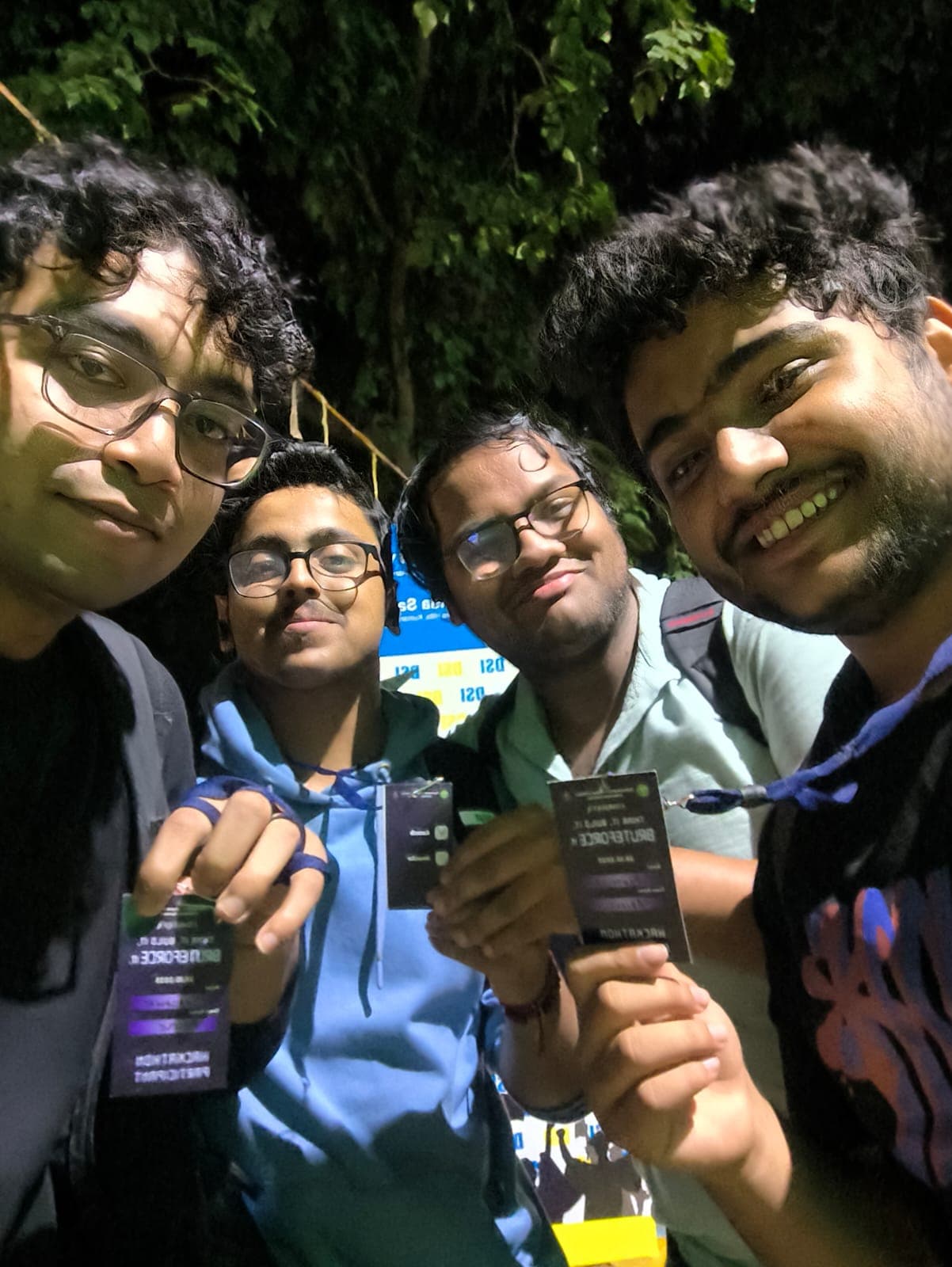
Four teammates leaning into a night selfie, each holding up a Bruteforce hackathon participant badge.

Checked in — badges out, before the clock started.

Built a marketplace where hotels and restaurants could list unsold food at 50% off before it went to waste. Users could choose free delivery, no-charge pickup, or walk in to collect — built as a React + Node web app with the Maps API handling location and delivery logistics, plus a companion Flutter mobile app.

What Went WrongWe split 12 hours across a React + Node web app and a companion Flutter app. That bought us a second screenshot and cost us depth on both — one client, actually finished, would have demoed better than two at seventy percent.
Judge FeedbackA judge went after the framing, not the build: in India, food that's been sitting reads as unsafe, not as a bargain. Halving the price doesn't fix that — it confirms the suspicion. We had designed the logistics without ever asking whether anyone would place the first order.
What I'd ChangeTwo things. Sell it as surplus from today's kitchen with a hard pickup-by time, not as leftovers at half price — the trust problem is a shelf-life problem in a marketing costume, and only one of those is fixable with copy. And free delivery on a ₹50 plate can't pay a rider: pickup should have been the default, delivery the paid upgrade.
Food WasteMarketplaceReactNode.jsMaps APIFlutter
Hackman24 HOURSTOP 9

Veriseal — Tamper-Evident Delivery Tracker

VIDEO: SOLDERING & PCB BUILD

An accelerometer detected sudden jerks or unauthorized box openings and streamed the data to our platform in real time. Every transit handoff was logged via QR scan, and the final scan at delivery surfaced the full chain of custody — every checkpoint, plus any impact or tamper events along the way. I built the software side: the React/Node platform, the QR scan-and-log pipeline, role-based access control separating what customers vs. the shipping company could see, and a blockchain layer for log integrity.

What Went WrongOne of our main hardware components burned out mid-build, weakening our final demo.
What We MissedA judge pointed out we hadn't considered that the hardware itself could be tampered with or hacked — a real gap in a system built to catch tampering.
HardwareIoTReactNode.jsBlockchainRBAC
Sandbox24 HOURS

Shadow Permission Analyzer

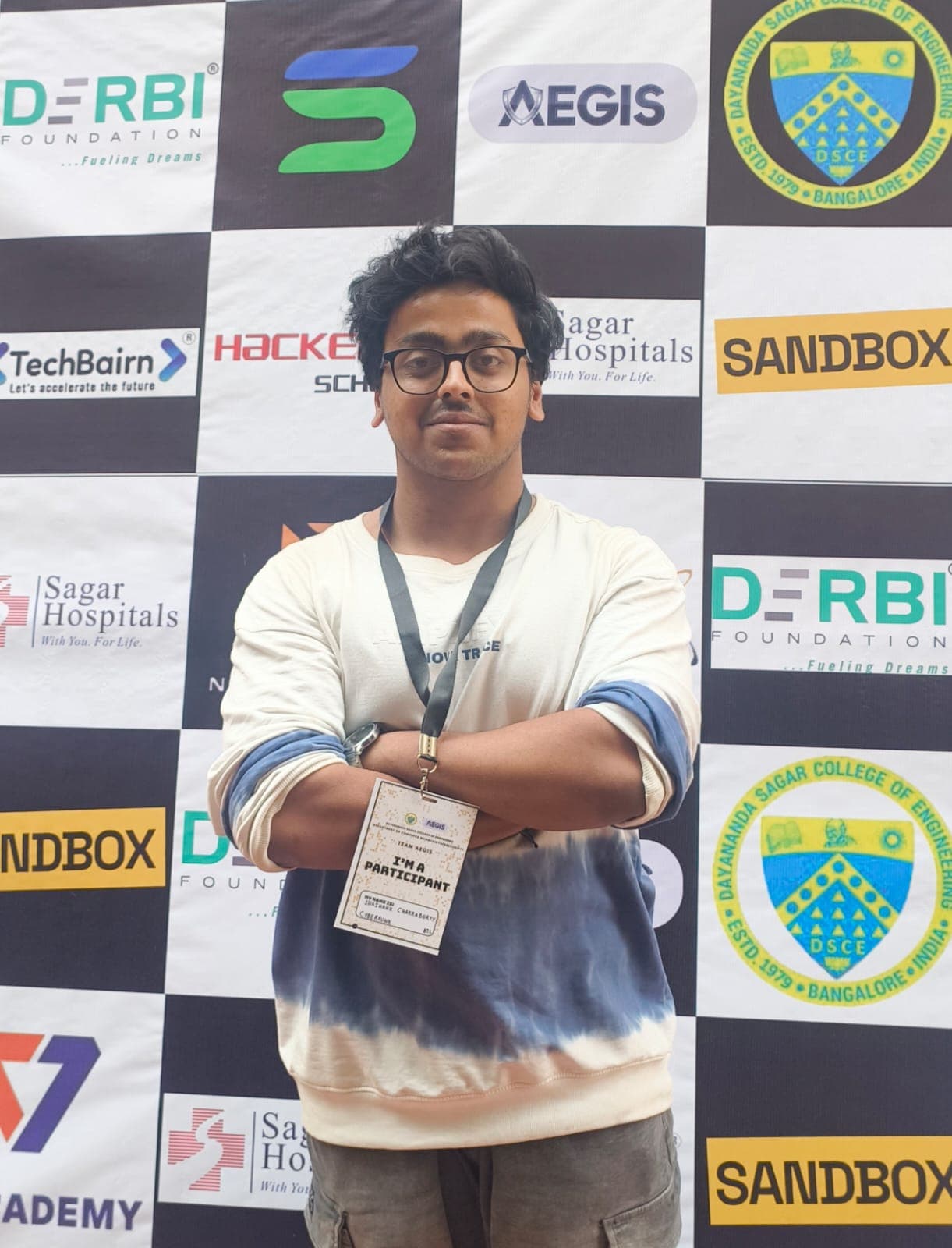
Shashank standing arms-crossed in front of the Sandbox sponsor backdrop, participant badge around his neck.

Badge on, in front of the Sandbox backdrop.

AWS IAM privilege escalation is a graph problem wearing JSON's clothing: a low-privilege user assumes a role, that role assumes another, and four hops later they are effectively admin — invisible in any single policy document. Pratyush and I built the pipeline end to end in the 24 hours. boto3 pulled users, roles, policies, and trust relationships into Neo4j as nodes and edges; BFS and DFS walked the graph for escalation chains; a React dashboard scored each chain by how privileged the target was, how many paths reached it, and how deep it ran. We traversed a mocked IAM dataset rather than a live account — it was the only way to have something to walk by hour three.

What We MissedIt only reads static IAM configuration, so it proves a path exists — never that anyone has walked it. With no CloudTrail history behind it, every finding is theoretical, and a security team buried in theoretical findings starts ignoring all of them.
ResultNo placement. It's the only build on this page that outlived its hackathon though — development kept going after the 24 hours, and it's written up in full under Featured Projects.
SecurityAWS IAM MockingReactFastAPINeo4jboto3
Pack Llama

Get in touch

Open to full-time backend and full-stack roles.

LinkedInGitHubX
© 2026 Shashank Chakraborty · Built with Next.js + Framer Motion